
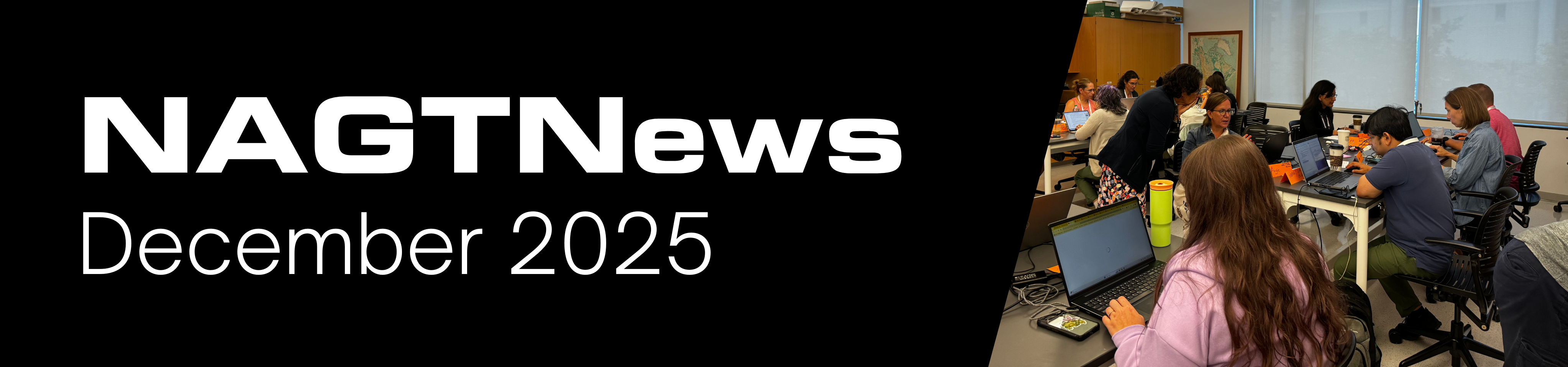



NAGT Sessions and Activities at the 2025 AGU Fall Meeting
 NAGT is pleased to sponsor a variety of geoscience education sessions planned for the Fall 2025 AGU meeting held in New Orleans, Louisiana. from December 15-19, 2025.
NAGT will not be operating a booth in the exhibit hall this year. But don't worry--our friends from the Science Education Resource Center at Carleton College will be present and have some NAGT materials on hand. As always, the booth in the exhibit hall is a great place to meet up and connect with other Earth educators, so be sure to stop by! You can find SERC at booth #717.
Renew your Membership Today
 NAGT is more than just a membership; it's a vibrant, supportive community where geoscience educators, researchers, and advocates come together to share ideas, push boundaries, and make a lasting impact. By renewing your membership, you contribute to the strength and vitality of geoscience education. Learn how your involvement is making a lasting impact!
Renew today and enjoy uninterrupted access to In The Trenches, the Journal of Geoscience Education, and this newsletter. Connect with others in your regional Sections and in topical Divisions. Access discounted professional development. Take advantage of leadership opportunities and eligibility for awards, grants, and scholarships!
Donations
Make a year-end donation to NAGT. Donating to the program fund gives us the flexibility to put your dollars to work where they are needed the most. Remember, you can always make your donation in honor or memory of someone.
Students, apply now for a Field Study Scholarship
Application Deadline: February 14
Each year, NAGT makes eighteen $750 awards to undergraduate students to facilitate their study of field geoscience. These awards, previously given to students who attend a traditional summer field camp, are now available for students attending field-based courses at any time of year and in any format: face-to-face, virtual, or hybrid. The intent of the awards is to support students' participation in intensive field courses in any aspect of geoscience (including geophysics, soil science, hydrology, etc.) that focuses on students practicing skills of field observation, data collection, analysis, and synthesis.
Learn More Application Deadline is February 14
Advocacy Committee's Draft Position Statements Open for Comment
The NAGT Advocacy Committee invites members to provide feedback on two NAGT position statements. In accordance with the NAGT procedure for approval of position statements, these statements (one new, one revised) are available for review and feedback by the membership before being voted on by the NAGT Council.
Supporting Justice, Equity, Diversity and Inclusion in the Geosciences
To advance Earth science education for all, it is critical that geoscience teaching, learning, and research be inclusive, conducted in ways that recognize and value diverse backgrounds, and are anti-racist, anti-ableist, and culturally responsive.
Teaching Biological Evolution
The National Association of Geoscience Teachers (NAGT) recognizes that the scientific theory of biological evolution is a foundational and robustly supported concept of science and, therefore, must also be a cornerstone of science education.
Comment on these position statements
 2026 Earth Educators' Rendezvous
University of South Carolina in Columbia, SC, July 20-23, 2026
Join us for the eleventh Earth Educators' Rendezvous (EER), held July 20-23, 2026, at the University of South Carolina in Columbia, South Carolina. The EER consists of 1/2-day to multi-day workshops and oral and poster sessions, along with a Share-a-thon, exhibitor showcase, and opportunities to connect with colleagues and the community. The program is designed to support researchers and practitioners working in all aspects of Earth education, including college faculty, graduate and undergraduate students, informal educators, education professionals, and K-12 teachers who are interested in improving their teaching about Earth. Registration, workshop programs, abstracts, and share-a-thon submissions open January 16, 2026.
Sign up to be an EER Exhibitor
Share your products or services with EER participants by taking advantage of the University of South Carolina School of the Earth, Ocean, and Environmental Sciences venue. Exhibitors can showcase their products and services throughout the event in a dedicated exhibitor area and will have a dedicated time to share information during the Exhibitor Showcase.
Sponsor EER2026
Gain visibility for your organization, program, or institution with EER Participants who work in the Earth, ocean, and atmospheric sciences and allied fields in the full range of institution types and organizations around the country.

Journal of Geoscience Education
The Journal of Geoscience Education is always looking for submissions related to learning and teaching in the geosciences and related domains.
Submit a paper to JGEView the latest issue of JGE
Article of the Month
Each month, the editorial staff for the Journal of Geoscience Education (JGE) selects a paper to be freely accessible. For December 2025, they selected "Factors influencing undergraduate geoscience instructors' decisions to attend institutional teaching-focused professional development programs and implement research-based teaching methods" by Collette Wilfong and Leilani A. Arthurs, and published online July 16, 2025. Congratulations authors!
In The Trenches
 As we near the end of the term, think back on your successes and challenges. Did you have a lab or lesson that went better than you expected? Did you meet a challenging instructional situation that taught you something new? Consider writing up your experience and sharing in In the Trenches.
In the Trenches (ITT) is an interactive online publication designed to provide a venue for NAGT members to learn about and discuss teaching strategies and resources, the work of NAGT committees, sections, and divisions, and other ideas relevant to Earth educators and education researchers. Share your work through ITT!
Suggest ITT Content Submit an Article
Teach the Earth

Teach the Earth (TTE) is a portal to thousands of resources from dozens of Earth Education websites. Managed by NAGT, this portal supports teaching and learning about the Earth by providing online resources for K-12 and undergraduate educators in the geosciences and related fields. Resources include classroom activities, course descriptions and syllabi, information about pedagogical strategies, topical collections, and more.
Featured Exemplary Resource
Measuring the Inclination and Declination of the Earth's magnetic field with a smartphone by Avradip Ghosh, University of Houston-University Park
This activity introduces students to the Earth's magnetic field and how to measure the Magnetic Declination and Inclination anywhere with nothing but a smartphone's built-in 3-component magnetometer for navigation. This activity uses the Physics Toolbox Magnetometer app, to measure the 3 components of the Earth's Magnetic field (Bx, By, and Bz) as a function of angle with respect to the Geographic North. By analyzing the data, one can obtain the Magnetic Declination, Inclination, and Magnetic Intensity (total magnetic field) of Earth's Magnetic field at the experimentation venue.

Nominate your Outstanding Teaching Assistants
Nominations due December 15
NAGT recognizes outstanding teaching assistants in geoscience education with up to 30 awards annually. Both undergraduate and graduate teaching assistants are eligible for the award. Award winners receive a one-year membership in NAGT. Award recipients will be acknowledged in the January 2026 NAGTNews. Submit a nomination by December 15, 2025.
Nominate Outstanding Earth Science Teachers
Nominations due February 1
Outstanding Earth Science Teacher (OEST) awards are given for "exceptional contributions to the stimulation of interest in the Earth Sciences at the pre-college level." Any teacher or other K-12 educator who covers a significant amount of earth science content with their students is eligible. Eight national finalists are selected, one from each NAGT regional section. Some sections also recognize state/province winners. Individuals may apply themselves or nominate a colleague for the award.
Do you have good news related to your geoscience education work that you would like to share with the NAGT community? Submit it to NAGT's Community Kudos!

Mentoring for Student Success Workshop
Online Workshop: February 23, 25, and 27, 2026, 12:00 pm PT | 1:00 pm MT | 2:00 pm CT | 3:00 pm ET (2 hours)
Are you ready to take your mentoring to the next level? This three-day, interactive online workshop is held in real time to empower mentors with practical tools and fresh insights to better support students as they navigate their research experiences. Through guided discussions and hands-on activities, participants will reflect on their own journeys as mentees and mentors, explore strategies for setting expectations and communicating effectively, and collaborate to address common mentoring challenges. Together, we'll focus on fostering student belonging, growth, and independence, helping them thrive as emerging geoscientists. Expect a supportive, participant-centered virtual space where you'll connect, share ideas, and learn alongside fellow mentors and facilitators.
Course Design Workshop
Online Workshop: June 8, 10, 15, 17, 22, and 24, 2026, 9:30 am - 11:00 am PT | 10:30 am - 12:00 pm MT | 11:30 am - 1:00 pm CT | 12:30 - 2:00 pm ET
Are you developing a new course or revising a course you have taught before? This workshop will help you use backwards design to generate assessments and instructional activities that meet both content and skills-based objectives. This highly interactive, synchronous online workshop will provide time for you to build foundational knowledge of best practices for course design, share strategies and exchange ideas with colleagues, work independently on developing your course, and provide and receive feedback from peers.
Early Career Geoscience Faculty Workshop
In-person at Macalester College, St. Paul, MN | June 21-25, 2026
Faculty in the first three years of their position are invited to join this multi-day workshop that features sessions on topics including effective and engaging teaching strategies, designing a course, conducting research projects with students, balancing professional and personal responsibilities, managing time, and establishing a research program. Build your network and community of early career peers.
Traveling Workshops: Bring Our Experienced Leaders to You
 The Traveling Workshops Program (TWP) brings NAGT's professional development program to you, working with you to customize a workshop to meet your group's needs. The TWP has well-tested workshop sessions on adapting to change, (re)designing your courses and curriculum, inclusive mentoring, supporting all students, and more. Are you preparing for a program review or responding to feedback from one? Have you seen changes in the faculty in your department through new hires or retirements? Do you feel you could do a better job serving your students? We can help you! Choose your workshop or learn more about the program.
Catch past NAGT Webinars on YouTube!
Did you miss a webinar hosted by NAGT? Check out the NAGT Webinar Series YouTube Channel ! Find a selection of recordings from webinars in the series and sponsored projects at your fingertips. Remember to subscribe!

Regional Sections
NAGT Regional Sections are the grassroots of geoscience education in North America. The 2023 reorganization of Sections focused members' efforts on regional issues. If you haven't connected with your section leadership, we encourage you to do so! Check out the Regional Section Web pages to learn more about your Section and efforts to engage and support geoscience education in your region.
Eastern Section
Plans are already being made for our spring 2026 meeting to be hosted by Callan Bentley at Piedmont Virginia Community College in Charlottesville, Virginia, May 14-16, 2026. If you have not attended a meeting in several years, or have never attended a meeting, why not make the plans now and consider joining us in Charlottesville, Virginia, for the spring 2026 meeting? Be sure to check out our newsletter: Fall 2025 NAGT-ES Bulletin CB.pdf.
Pacific Northwest Section
Our next annual meeting will be hosted in June 2026, at Highline College in Des Moines Washington by Jacob Selander, jselander@highline.edu. For more information on our upcoming June 2026 meeting or the past June 2025 Annual Meeting in Portland, Oregon, click here.
Rocky Mountain Section
Be sure to find us at the Rocky Mountain GSA Conference in Albuquerque, May 17-20, 2026.
Topical Divisions
 Geo2YC Division
The Geo2YC Division is a home for NAGT members who have a shared professional interest in geoscience education at two-year colleges. Two-year college faculty are an integral part of NAGT. Explore the seasonal Geo2YC Newsletter!
 Geoscience Education Research (GER) Division
The Geoscience Education Research Division (GER) is committed to the promotion of high-quality, scholarly research in geoscience education that improves teaching and learning in K-12, higher education, and informal learning environments.
Teacher Education (TED) Division
The NAGT Teacher Education Division (TED) seeks to improve geoscience teaching by improving teacher content and pedagogical knowledge and by encouraging research on best teaching practices. TED is in search of a new Media Director! We have a great leadership team. Do you want to know what we've been up to? Do you want to stay informed about how the Teacher Education Division supports you, as members of NAGT and TED? Find us on Facebook!

Instructor Survey: What skills do students develop in your courses?
Complete the survey by December 31
We are surveying instructors to learn more about the skills students develop in undergraduate geoscience courses. Please help! We are recruiting instructors of undergraduate geoscience courses to complete a survey about the skills and dispositions students practice. If you teach an undergraduate course for geoscience majors at a U.S. institution of higher education, please follow this link: https://boisestate.az1.qualtrics.com/jfe/form/SV_4N1ZRpuiEqDLWZw to complete the survey. It should take you about 10 minutes to complete.
Survey responses will be used to better understand the practice of workforce skills by geoscience students and to identify potential professional development needs of geoscience instructors.
Thank you for your help,
Karen Viskupic and Anne Egger
This research has been reviewed by the Boise State University IRB and approved as protocol #IRB25-392
Nominate for the Outstanding Undergraduate Science Teacher Award
Applications due December 31, 2025, at 11:59 pm CT
The Society for College Science Teachers (SCST) is seeking nominations for the 2026 Outstanding Undergraduate Science Teacher Award (OUSTA). A nominee need not be a member of the SCST. Nominations may be made by colleagues or students, and self-nominations are also encouraged! The award includes a cash award, membership in SCST, and the opportunity to present at SCST's Virtual Poster Symposium.
The purpose of the OUSTA is to recognize the achievements of our teaching colleagues who have enhanced the profession as outstanding teachers of science. This annual award is based upon a selection process that evaluates nominees according to the following ranked categories: 1) teaching excellence; 2) scholarship; and 3) service. For details regarding the nomination and application process, visit: https://thescst.org/awards/ousta.
Please send the names of potential nominees/applicants to Haney@geosci.msstate.edu. We will follow up with everyone to provide further materials and details about the application process. We are also interested in hearing from you if you are considering self-nomination so that we can guide you through the process. Questions? Email - Haney@geosci.msstate.edu
Save the Paleontological Research Institution!
![https://www.priweb.org/mortgage-campaign-landing-page]](https://cdn.serc.carleton.edu/images/nagt/news/nagtnews/pri_impact_numbers.webp) PRI is an essential Earth Science research and educational resource center founded over 90 years ago. Each year, PRI reaches 30,000 visitors through the Museum of the Earth and hosts extensive, accessible online resources used by more than 1 million educators, scientists, and natural history enthusiasts. You may be familiar with some of these resources from PRI's Earth@Home site, including the NSF-supported Teacher Friendly Guides to Earth Science and Climate Change, Regional Guides to Earth Science, the Center for Climate Change Education, the Digital Encyclopedia of Earth Science, the Digital Atlas of Ancient Life, and virtual collections that see widespread use in remote learning settings. Additionally, teacher professional development programming run by PRI directly trains (or engages) over 1,500 teachers a year, who in turn reach hundreds of thousands of students. Learn more about and support PRI today.
PRI is an essential Earth Science research and educational resource center founded over 90 years ago. Each year, PRI reaches 30,000 visitors through the Museum of the Earth and hosts extensive, accessible online resources used by more than 1 million educators, scientists, and natural history enthusiasts. You may be familiar with some of these resources from PRI's Earth@Home site, including the NSF-supported Teacher Friendly Guides to Earth Science and Climate Change, Regional Guides to Earth Science, the Center for Climate Change Education, the Digital Encyclopedia of Earth Science, the Digital Atlas of Ancient Life, and virtual collections that see widespread use in remote learning settings. Additionally, teacher professional development programming run by PRI directly trains (or engages) over 1,500 teachers a year, who in turn reach hundreds of thousands of students. Learn more about and support PRI today.
Bringing Coding the Geoscience Classroom - Virtual Workshop
Free Online Workshop, January 13-14, 2026, 11:00 am - 4:00 pm ET daily
Computational skills and tools are increasingly important in the workforce and provide a powerful mechanism to explore large datasets. To prepare students for this need, it is crucial that instructors integrate activities that introduce students to these tools, increasing their familiarity with tools and building their computational and quantitative skills over the course of their academic career. This workshop is designed to equip participants with the knowledge and tools to effectively integrate Python and open-source workflows into their undergraduate geoscience curricula, providing practical experience in building classroom activities and leveraging real-world data to develop students' twenty-first-century skills.
Participants will discuss opportunities and challenges of teaching computation using Python, learn how to access and use basic Python and computing tools, work through example activities with geologic applications, and work toward developing an activity for classroom use.
Current undergraduate instructors, including community college, introductory-level, as well as major-level instructors, are all encouraged to apply to attend this free workshop.
Instructor Survey: Do you use analogies in your geoscience classroom?
Complete the survey by February 10, 2026
Do you use analogies in your geoscience classroom? Do you teach upper-level/majors courses? If yes, please consider participating in our survey-based study! We are exploring geoscience instructor perspectives on analogies in upper-level geoscience courses. This short 10-15 minute digital survey will ask questions surrounding how you, as an instructor, use analogies in your classroom, what analogies you find yourself using, and how you feel about analogy effectiveness. Compensation in the form of a $20 Amazon gift card will be offered to the first 75 participants.
Before beginning the survey, take a second to think about what analogies you have used throughout your time as a geoscience instructor. You will be asked to provide an example.
If you are interested in participating, please click the following link to access the survey: https://niu.az1.qualtrics.com/jfe/form/SV_39tJYadtTdT289U
The survey will be open until February 10th, 2026, after which compensation will be emailed to the first 75 participants.
CIRES-CEEE Resilient Futures Teacher Workshop 2026
Boulder, Colorado: July 28-30, 2026
Pre-registration is now open for the 2026 Resilient Futures Teacher Workshop! Middle school and high school educators are invited to a three-day in-person teacher workshop. Engage with sessions on education resources, including scientist talks, lab tours, and networking sessions by CEEE, NOAA, and friends. This session will cover topics such as climate science, natural hazards, water resources, climate mental health, data literacy, and more. Participants will leave with a variety of classroom-ready lessons and activities. They can receive a 20-hour PD certificate OR 1-2 Continuing Education credits from the University of Colorado Boulder upon course completion.
After pre-registration closes, a small registration fee will be required when the official registration opens. Participants who complete the course will receive a gift card.

 Looking to connect with a wide audience in the geoscience education community? Post your job openings, postdoctoral positions, internships, assistantships, or undergraduate research opportunities on the NAGT Career Hub! Your posting will be featured on the NAGT Career Hub website, posted on NAGT's social media, and included in next month's NAGTNews newsletter!
Assistant Professor of Hydrogeology at Western Washington University
The Geology Department at Western Washington University (WWU) invites applications for a tenure-track Assistant Professor position specializing in Hydrogeology to begin September 16, 2026. They seek individuals who are enthusiastic about teaching and who will establish a productive research program that involves undergraduate and Master's level students. The ideal candidate will support our department's ability to produce workforce-ready geoscientists.
Review of applications begins December 15, 2025, and continues until the position is filled.
Earth Sciences Instructor at North Orange County Community College District
Teach lecture, laboratory, and field courses in geology, earth science, meteorology, oceanography, climate science, and related courses to a diverse student population. Participate in curriculum development and serve on department, division, college, and district committees as necessary to maintain and improve the instructional program; participate in appropriate professional development activities. All applicants must have demonstrated sensitivity to and understanding of the diverse academic, socioeconomic, cultural, disability, gender, gender identity, sexual orientation, and ethnic backgrounds of community college students, faculty, and staff. The applicant must be able to demonstrate how these factors relate to the need for equity-minded practices within the classroom.
The application closing date is February 5, 2026.
Student Opportunity: Summer Program for Undergraduate Research (SPUR) project in STEM Education Research at the University of Utah
Applications due January 25, 2026
Learning to Observe: Teachers Learning Through Scientific Observation in Field Geology: This research aims to build knowledge about how secondary science teachers develop their observational skills in the disciplinary context of field geology. To achieve this goal, the project implemented two iterations of a year-long professional course for secondary science teachers that foregrounded scientific observation of geologic processes in the field during 2023 and 2024.
Currently, the project team is enacting qualitative and quantitative analysis of video, audio, and written work collected over these two iterations. Analysis examines how teachers learn to observe in ways that relate to their 1) conceptual knowledge systems, 2) social interactions with peers and the course instructors, and 3) cultural contexts and backgrounds. Results will contribute to improved K-12 science instructional materials.

Available Samples 
Desired Specimens
- A small rural school needs a classroom rock and mineral collection
- #50States50Rocks
- Precambrian chert and Stromatolites
- Science Department Head/Earth Science Teacher
- Deformation Microstructures
Post available samples and desired specimens in the Rock and Mineral Exchange
Contribute content to NAGTNews today | Share photos from an NAGT event