Volume 15, Issue 1| Spring 2026
Foundations
NEWSLETTER OF THE NATIONAL ASSOCIATION OF GEOSCIENCE TEACHERS GEO2YC DIVISION
![[creative commons]](/images/creativecommons_16.png)
In this Issue:
- President's Column
- Funding opportunities - apply for support for your ideas - April 15 deadline
- Early Career Workshop - March 31 deadline
- Geo2YC wants to hear from you
- Geo2YC pencil pictures
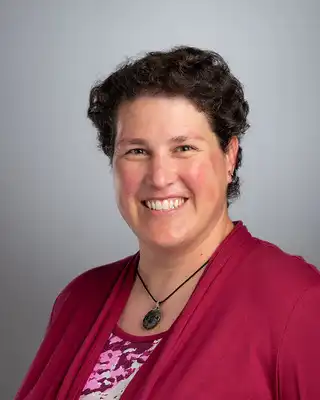 Beth Johnson, 2025-2026 Geo2YC President
![[reuse info]](/images/information_16.png)
President's Column
Beth A. Johnson, University of Wisconsin-Oshkosh
First, happy Spring Break! I hope you are all able to take a little time to take a deep breath, do something purely for your own self-benefit, and maybe get a little extra sleep for a few days. But soon, our thoughts will turn to geoscience class field trips and all the fun we get to have on them!
For me, returning to field trip sites with my students is like introducing them to an old friend. I am genuinely happy to visit those sites. I love teaching my students how to interpret their secrets. I try to emphasize the importance of making basic observations – What color is the rock? Is it flat-lying? Is there more than one layer? – in order to get them to actually look at the rock instead of waiting for me to tell them the answer. But as so many of us know, getting students to actually complete the tasks you assign them on a field trip can be akin to raising the Titanic with tweezers. So, what can we do to get our students to actually participate in a field trip instead of standing around?
One way I have been able to address this goes back to all the online webinars I participated in during the first few weeks of COVID lockdown. I took a webinar to learn more about virtual field trips, trying to soak in as much information from those who had much more experience teaching online than I had at the time. I found wonderful resources through Arizona State University (https://vft.asu.edu/), UC-Berkeley EPICC Virtual Field Experiences (https://epiccvfe.berkeley.edu/), and numerous Google Earth field activities. At first, it was a way that I could take my students on a COVID-safe field trip. Once we returned to face-to-face teaching, it became a no-cost way to add an extra field trip to the class. But now, it has become an integral part of how I prepare my students to go on their real-world field trip later in the semester. We start with a virtual field trip so they can practice using basic observational skills. The class period before the field trip, I have them revisit the assignment and identify what observational skills they used, such as rock color, orientation, counting the layers, etc. I remind them that they didn't need any special skills or scientific training to make those observations – they already knew how to do them! And that's where all science begins. When I take them on the field trip, I remind them about those skills and set them to work. Although there is still a little grumbling that takes place, the student engagement has improved significantly!
We all have that list of things in our classes that we've been meaning to update or change – different lecture slides, updating an assignment – but sometimes other things get in the way. I wish I had been able to integrate these virtual field trips into my classes sooner, but I'm also not sure I would have thought about using them in the same way had it not been for the desperation of trying to give my students a good field experience at a time when the world was isolating from the corona virus. The lockdown forced me to take advice from others and make those updates to my classes that I had been putting off.
So why am I telling you all of this? Because we don't need to wait for a global disaster to learn new things. One way you can learn new things is to participate in the Geo2YC Fireside Chats. It's a great way to connect with other geoscience instructors from the comfort of your own home. Have an idea for a chat theme? Please email me! Don't know what to say? That's okay – it's all very informal. But another way is to consider attending this year's Earth Educator's Rendezvous in Columbia, South Carolina from July 20-23. Come meet other geoscience instructors from around the country to share your ideas, learn new activities, and maybe even participate in your own field trip or two! You'll even have a chance to chat with me while I'm there as I'm collaborating with a colleague to teach a workshop on climate change education (Hint hint!). Registration is open now and I hope you will all be able to come. Check out the website for more details. And, if you could use a little help to defray the costs of attending, the Geo2YC Division has Faculty Development Grants you could use to help cover up to $100 of your travel expenses to the conference.
So whether your Spring Break has come and gone already or whether it's just around the corner, I hope you are able to use this time to relax, rejuvenate, and enjoy yourselves by getting out into the field!
We have money we want to give to you!
Apply for a Geo2YC Faculty Development Grant! Next deadline is April 15.
The Geo2YC Division is here to support our members financially - we offer $500 to help facilitate workshops or activities for 2YC faculty that are planned by our members, and $100 travel grants for professional meetings, including GSA, AGU, EER, regional NAGT meetings, and more. Historically, we've received few applications - so the likelihood of funding is high - let us help you. Rolling deadlines annually are on April 15 and September 15. Apply here.
Apply for a Dorothy Stout Grant! Next deadline is April 15.
One Dorothy Stout Grant is given annually to a community college instructor ($750) as well as a community college student ($750).
Early Career Geoscience Faculty Workshop 2026
June 21-25, Macalester College, MN
Application Deadline: March 31, 2026
https://serc.carleton.edu/NAGTWorkshops/earlycareer2026/index.html
If you are in your first three years of a faculty position (full-time or adjunct), please apply to join us for a multi-day workshop in a stimulating and resource-rich environment where you will participate in sessions on topics including effective teaching strategies, course design, establishing a research program in a new setting, working with research students, balancing professional and personal responsibilities, and time management. Participants must have a faculty position at a two-year or four-year college or a university at the time of the workshop and must be in their first three years of teaching or starting a position in the Fall. The workshop is offered by the NAGT On the Cutting Edge professional development program for geoscience faculty.
Registration fee: $1800 (includes accommodations and some meals)
Travel is not included in the registration fee and participants or their home institutions must provide transportation to and from the workshop. In cases where the cost of attending this workshop would cause financial hardship, some stipends will be available by application to partially reimburse participants with a demonstrated need for registration and travel. We will notify participants of their stipend application status prior to the registration deadline.
Hey members - let's start sharing more!
You may have noticed this issue is a bit light on content - that's because we need to hear from you! Please share your Geo2YC experiences with us - we are always looking for:
- Field Notes - tell us (and show us with pics) about field trips you do with students, especially if it's outside on your campus or in urban areas. If you are conducting field work with colleagues, tell us about that too.
- Geoscience/geology/STEM clubs/professional society chapters - how are you encouraging your students to engage beyond the classroom? Tell us about meetings or outreach events...show us your t-shirts! Consider getting your students to write about it for us.
- Grant projects - have you had a funded grant? We would love to hear about your projects.
- Teaching experiences - have you tried a new activity that went well? Did you try something that totally flopped? Do you love a particular lesson from the SERC collection? Let's talk about what we do best.
- Favorite rocks and fossils - we all have favorite samples in our teaching collections - share yours with us!
- Book reviews - have you enjoyed a good geo-related book (fiction or non-fiction?) lately? Tell us about it.
Please note, you don't have to write a lengthy, fully perfect article. A picture and a paragraph or two can tell the full story...and don't worry about typos/grammar...your trusty newsletter editor's got you covered.
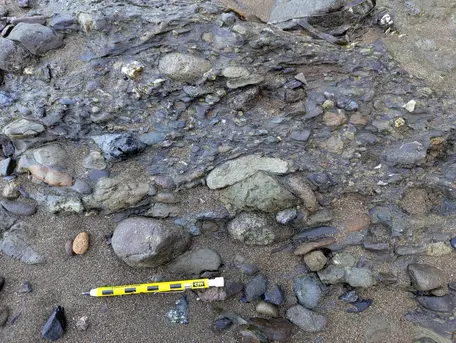
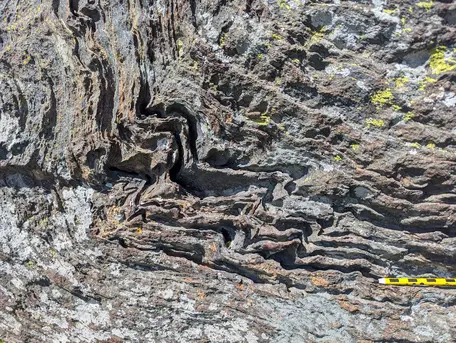
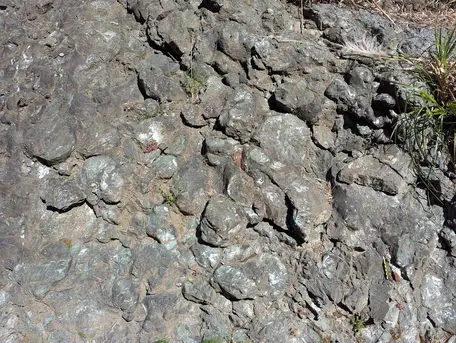
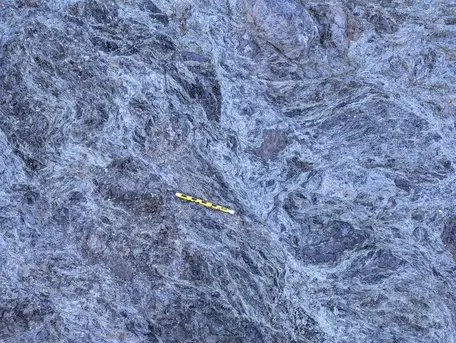
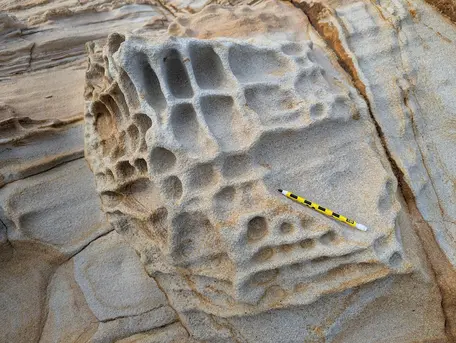
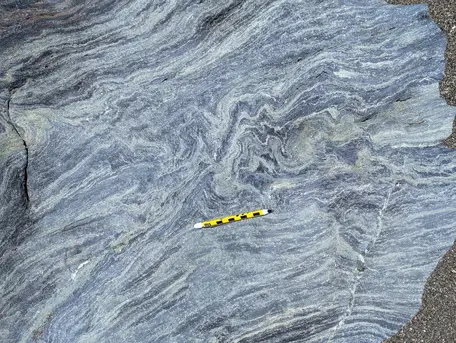
Where in the world are NAGT Geo2YC pens and pencils?
Email any of the Geo2YC officers to get your own Geo2YC writing utensils - we'll even send some to share with students. Send us your pen and pencil pictures to share in the newsletter. This issue's pictures are from Callan Bentley, who along with Pete Berquist and Lynsey LeMay, took a cohort of VCCS students to the San Francisco Bay region for a spring break field trip.