
Teaching Critical Thinking in a Large Lecture Class
Critical thinking is a daunting topic to teach, even more so within the confines of a large lecture class. This article describes an approach for teaching critical thinking that uses an examination of flat Earth arguments as a tool to teach skills for evaluating information. This approach uses a minimum of class time and can be adapted to use other myths and conspiracy theories.
HOW DO WE TEACH CRITICAL THINKING?
Professors are hired to teach and share their knowledge of their content area. We specialize in different areas, and the jobs we apply for are organized by those content areas (for me, this was paleontology, but it could be any academic area). At the same time, I think all teachers have a desire to help their students develop the critical thinking skills that they will need in our courses and beyond. Indeed, I regard teaching critical thinking as the most important part of my job as an Earth science educator. Understanding the geologic timescale is important, but critical thinking skills can be applied to all areas of life.
Critical thinking itself is often a nebulous concept. Larsson (2017, p.32) observes that this definitional issue "... is an elusive and complex one, and that it is futile to attempt to capture it in any definition." Generally, it is thought to involve the ability to critically assess conflicting views. However, assessing conflicting views depends heavily on the background knowledge we already have. No two students will have the same set of background knowledge. As a result, what might be a fair assessment of critical thinking for one student would not be fair to another. Teaching critical thinking seems to require an individualized approach or individual attention.
Whatever it is, it cannot be easily taught (McCaffree & Saide, 2014; Willingham, 2007), nor can it be assessed with a standardized test (Larsson, 2017). If it cannot be easily assessed (via a test), we cannot know how effective our teaching was, nor if any particular student absorbed the skills that comprise critical thinking. Furthermore, without some sort of test with simple-to-understand results, how can we make policymakers understand what we are doing? For simplicity's sake, I will define critical thinking herein as the ability to fairly evaluate conflicting positions and to be able to understand the reasoning behind a position with which one disagrees. This definition is influenced by the work of Haber (2020).
THE VESSEL
For too long, we have implicitly had an over-simplified model of how students learn: the so-called empty vessel model of knowledge. We have assumed that errors in thinking are the result of not having the correct facts. We thought the error of an 'empty vessel' could be corrected simply by 'pouring' the correct facts into their mind. In other words, cognitive errors were the result of a deficit of knowledge. The empty vessel model is intuitive, simple, and wrong.
As a result of the empty vessel model is that, at least at the college level, we have counted on the complexity of our content to do the heavy lifting of teaching critical thinking for us. Critical thinking, we hoped, would be a byproduct of a student successfully learning our content. This has seemingly been unsuccessful in most cases, and it has resulted in the persistence of views of science that are, at the least, problematic. The proliferation of conspiracy theories in society, now more rapid due to the internet and social media, is the reward we reap.
MY EXPERIENCE
I am an invertebrate paleontologist at the State University of New York at Fredonia, and I have been teaching undergraduates for the last fifteen years. I like to flatter myself that I can think critically. How did I learn to do this? My formative experience in critical thinking happened to me as an undergraduate, when I had the opportunity to participate in a graduate seminar as a fly on the wall. The structure of the seminar was that a couple of scientific papers on a given topic would be assigned, and one student would present on them each week. Following the presentation, the papers would be discussed. What was eye-opening to me was watching everyone find the chinks in the papers' scientific armor. They asked questions about the experimental design, about the data, and about the underlying assumptions. They argued, and rhetorical blood was spilled. Then everyone went out for drinks and pizza together at the Airliner. The following camaraderie emphasized that everyone was more than the ideas they discussed. Everyone was more than their ideas—right or wrong.
A fly-on-the-wall experience in a seminar is not the only way to learn critical thinking; and certainly, my following two takeaways are not the only lessons to be learned. One, that everything is provisional and open to revision upon new information. Two, that to appreciate what new data can teach us, we need to separate the ego from the idea. Defending an idea that has no support, merely because it is our idea, is a quixotic quest. Everyone is wrong at one time or another, and it is better to just accept that your idea doesn't work than to try to force it. In a classroom, that might look like modeling a wrong guess out loud, or explicitly telling students it's fine to abandon a position mid-discussion.
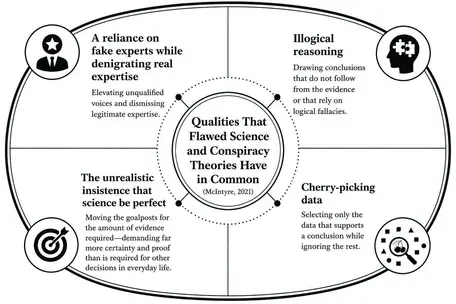
This final realization is the opposite of what movies and media often teach us. They lionize the lone scientist who toils ceaselessly to prove their idea. Think of Peter Venkman from Ghostbusters or Rick Sanchez from Rick and Morty. A scientist who does so is not learning from the world around them—they are trying to conform the world around them to their ideas. It is an archetype of a bad scientist: one blinded by the need to be right.

MY APPROACH
With these ideas, I set out to develop a way to help students develop their critical thinking skills. When one envisions a class that teaches critical thinking, small, seminar-style classes come to mind. Instead, my trial case was one of the most difficult arenas: the large, general education lecture hall. Teaching critical thinking in a large lecture class like that is a daunting prospect, so I scaled my goals accordingly. I used my introduction to oceanography class (called Blue Planet), and I added a little bit to the end of each lecture to aid in this endeavor (about five minutes). My goals were to a) demonstrate what science and critical thinking are, b) build media literacy skills while showing their importance, and c) to model the art of asking questions (i.e. 'asking the next question'). Instructors with different personalities might adapt these insights in different ways, perhaps using more peer-to-peer evaluation and discussion.
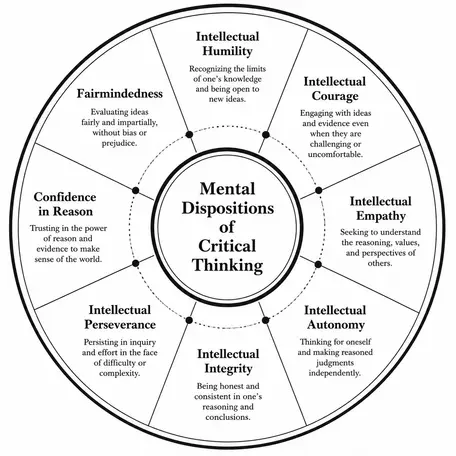
Early in the class, I had an entire lecture devoted to explaining what science is, and how it works. I try to emphasize that it is a process—a way of thinking. This contrasts with the notion that many students pick up—that science is a sort of book of knowledge, and when you finish learning the material, you are done. I link this way of thinking to how we approach problems in everyday life. My approach is heavily influenced by Bickmore and Grandy's (2014) accessible essay, "Science as Storytelling" (see also Bickmore et al., 2009a, b). It is in this part of the class that I discuss the dispositions of critical thinking (Haber, 2020). As a sort of cautionary tale in another lecture, I tell the story of Soviet botanist Trofim Lysenko to show the real-world impact of his flawed view of science.
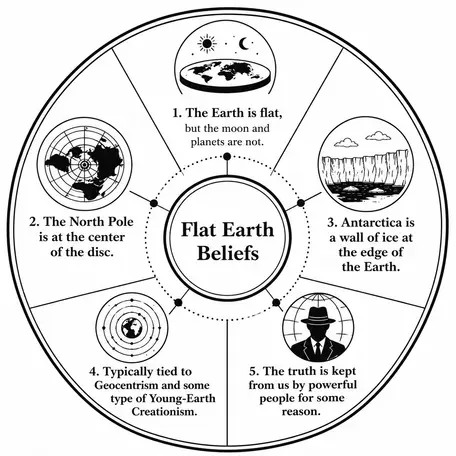
After setting the stage over the first weeks of class, I presented a flat Earth argument at the end of class. Admittedly, I am a rather sarcastic person by nature, and this managed to bleed through in my treatment of the arguments (more on this below). One of the early flat Earth arguments I tackle is the significance of Eratosthenes. Eratosthenes (b.276-d.194 BCE) was the Greek polymath who used the shadow of an obelisk in Alexandria and the lack of a shadow in a well in Syene to estimate the Earth's circumference with a great degree of accuracy. FEers, to their credit, do not hide from Eratosthenes; instead, they claim that his math was wrong. Eratosthenes used his arc measurement technique. FEers cite a different, even older ancient Greek: Pythagoras (b.570-d.495 BCE). They use his eponymous Pythagorean theorem (a2 + b2 = c2). FEers treat the Sun-Syene-Alexandria system as a triangle (with a flat surface between Syene & Alexandria). They argue that how you solve this problem is colored by your assumptions (Earth round vs. flat). Rhetorically, I ask, how can we resolve this?
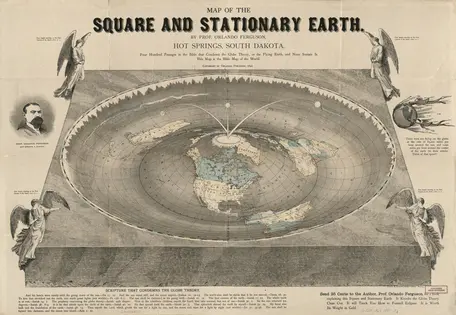
Getting us to question our assumptions is a good rhetorical move by the FEers. But, while the Pythagorean theorem may make sense of the distances on Earth, the real story is found when students look at the implications of the FEer math for the distance of the Sun from the Earth. A key difference between the two approaches is the distance of the Earth from the Sun and the nature of the Sun. For the FEers to use the Pythagorean Theorem, they need to assume the Sun is a point source, whereas Eratosthenes treats the Sun's rays as parallel. Depending on the numbers FEers use, their approach finds an estimate of the Sun's distance as 3,000-4,000 miles away. It turns out, that another ancient Greek scientist had already estimated the Earth's distance from the Sun. Aristarchus (b.310-d.230 BCE) used trigonometry and parallax to estimate the Earth-Sun distance. While Aristarchus had a significant error associated with his calculations, his numbers made the 3,000-4,000 mile distance laughable. My point is that once you push beyond the plausibility of the initial FEer argument, you discover nothing but inconsistencies. There is one world out there, and each way that we look at it should tell the same story.
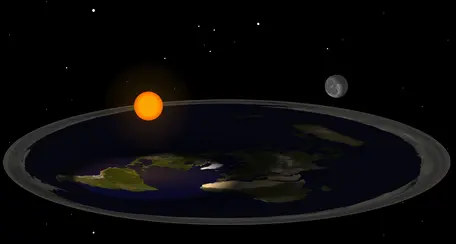

Another topic I tackle is gravity. The modern scientific understanding of gravity as a force that pulls objects towards one another and increases in strength with increasing mass, just does not work on a flat Earth. Thus, we have to examine how FEers conceptualize gravity; FEers envision gravity as a 'downward' pulling force. I then take these two models of gravity (mass-based or downward-based) and I apply them to our two models of the Earth (flat and spherical). Mass-based gravity does not work on a flat Earth, just as downward-based gravity does not work on a spherical Earth. But, I argue, downward-based gravity does not work on a flat Earth either. Downward-based gravity cannot explain the orbits of planets and satellites, atmospheric circulation, or tides (an important upcoming topic in my class).
WHY DO PEOPLE CONTINUE TO BELIEVE WEIRD THINGS?
I wrap up the semester by asking the question (paraphrasing a book by Shermer, 2002): "Why do people believe weird things?" The first point I make is that my approach throughout the semester (being flippant and sarcastic) is exactly the wrong approach. Facts do not win these battles—in fact, they often cause the 'backfire effect': "I must really be right about the Earth being flat if they sent my good friend out to try to convert me." Beliefs, like FE or others, can be a deep part of a person's belief system and community identity. Leaving their community is often out of the question. Here, personal connections seem to be key—understanding what motivates the belief and showing them that you can still be a good person without believing the Earth is flat. Science denial exists on a spectrum—rational beliefs can be coupled with irrational ones. In fact, each one of us probably has hidden 'alternative conceptions' (misunderstandings about how the world works).
Maybe this is a dispiriting conclusion—that there is no magic pill to eradicate conspiracy theories. But the realization of the importance of personal connections makes each critical thinker that much more important. Does my approach work? For now, I'm unwilling to run the experiment with the control group. The students enjoy it, and they believe that they get something out of it. I think that is the most I can expect out of a general education lecture audience. One student said in an evaluation, "I think [this] module was a very interesting way of showing students how to critically think about what you see on media and how to analyze it ... it was honestly very interesting to see the flat earther's way of thinking."
THE NUTS AND BOLTS
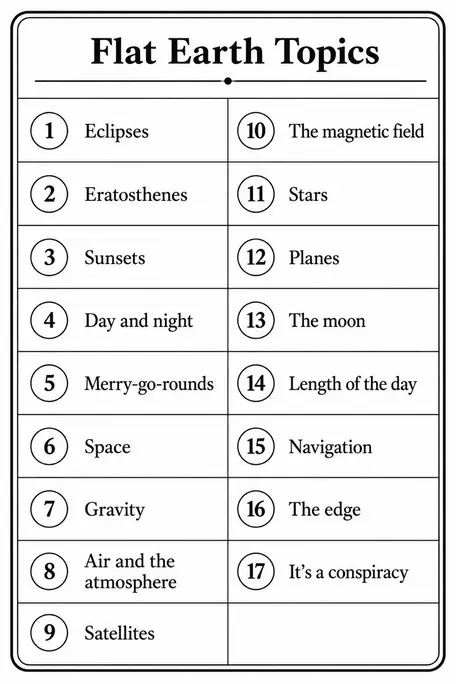
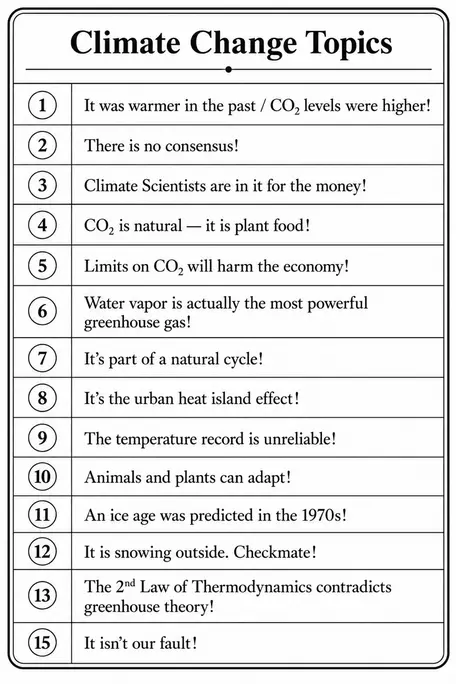
In total, I devote seven lectures to information literacy, the nature of science, and the dispositions of critical thinking. I cover seventeen different flat Earth arguments during the semester as well as fourteen climate change arguments. The biggest struggle I have encountered is the timing that I have chosen: the end of class. While I had hoped that by putting this at the end of class students would perk up, some students are just too mentally worn out (or sleepy) by the end to pay much attention. As one student said, "For me personally, I sometimes had a hard time paying attention because this section is at the end of class and my mind starts to wander."
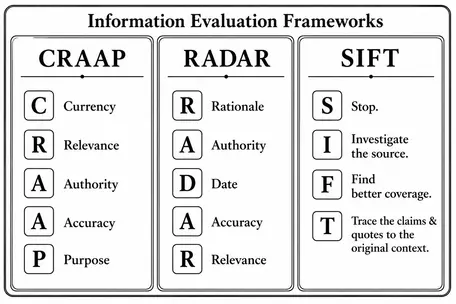
For me as an instructor, I find the modules where I discuss lists (the critical thinking dispositions or the information literacy acronyms) to be the hardest to deliver simply because I have not found an exciting and attention-grabbing way to present them yet. My assessments of this approach to teaching critical thinking are embedded in online questions, which, in all honesty, is not a sufficient model of assessment. But, as this entire module is just a small part of each class, I have devoted more energy to assessment in the other core areas of the class. As AI becomes more pervasive, this mode of assessment may no longer be satisfactory.
An oceanography class is not the only place this approach could be used. I have contemplated creating a similar set of content using young-Earth creationist arguments. Cryptozoology, alien archaeology, and crystal healing are all other potential touchstones to use (I highly recommend Prothero's (2020) book "Weird Earth: Debunking Strange Ideas About Our Planet" as a great place to begin looking for topics). Adapting this approach to a class with accompanying lab sections could create the opportunity for small group discussions that cannot easily be done in a big lecture hall.
Thus far, I have not knowingly had a FEer in one of my Blue Planet classes. In preparation for such an eventuality, I constantly convey my willingness to engage in one-on-one discussion on these topics outside of class. In that space outside of class, I can more sensitively address the student's question and learn what is behind their belief. Discussing a student's ideas about a flat Earth (or any other pseudoscience) in class would be counterproductive.
ACKNOWLEDGEMENTS
Many colleagues have given me their ear over the years to discuss these ideas. Dr. Laura Barden-Gabbei helped start me down this road by introducing me to the intersection between research, teaching, and learning. Drs. Mike Jabot (Fredonia) and Jo Wolfe (Toronto) provided helpful feedback and encouragement. Early versions of these ideas were first presented as a Buffalo Association of Professional Geologists' professional development lecture (fall 2023), at the spring 2025 Northeast sectional meeting of the Geological Society of America in Erie, PA, and as a SUNY Fredonia Robert W. Kasling Memorial Lecture in the fall of 2025.
AI STATEMENT
AI technology was used to turn lists into figures with a unified style (figures 1-4, 7-8).
REFERENCES
Bickmore, B. R., Thompson, K. R., Grandy, D. A., & Tomlin, T. (2009a). Commentary: On teaching the nature of science and the science-religion interface. Journal of Geoscience Education, 57(3), 168–177. https://doi.org/10.5408/1.3544261
Bickmore, B. R., Thompson, K. R., Grandy, D. A., & Tomlin, T. (2009b). Science as storytelling for teaching the nature of science and the science-religion interface. Journal of Geoscience Education, 57(3), 178–190. https://doi.org/10.5408/1.3544263
Bickmore, B. R., & Grandy, D. A. (2014). Science as storytelling. BYU Studies Quarterly, 53(4), 37–60. https://scholarsarchive.byu.edu/byusq/vol53/iss4/4
Blakeslee, S. (2004). The CRAAP test. Loex Quarterly, 31(3), 6-7.
Caulfield, M. (2019, June 19). SIFT (the four moves). Hapgood. https://hapgood.us/2019/06/19/sift-the-four-moves/
Haber, J. (2020). Critical thinking. The MIT Press.
Larsson, K. (2017). Understanding and teaching critical thinking—A new approach. International Journal of Educational Research, 84, 32–42. https://doi.org/10.1016/j.ijer.2017.05.004
Mandalios, J. (2013). RADAR: An approach for helping students evaluate Internet sources. Journal of information science, 39(4), 470-478. https://doi.org/10.1177/0165551513478889
McCaffree, K., & Saide, A. (2014). Why is critical thinking so hard to teach? Skeptic, 19(4), 54–57.
McIntyre, L. C. (2021). How to talk to a science denier: Conversations with flat Earthers, climate deniers, and others who defy reason. The MIT Press.
Prothero, D. R. (2020). Weird earth: Debunking strange ideas about our planet. Red Lightning Books.
Shermer, M. (2002). Why people believe weird things: Pseudoscience, superstition, and other confusions of our time (Rev. and expanded ed.). Henry Holt and Company.
Willingham, D. T. (2007). Critical thinking: Why is it so hard to teach? American Educator, 31(2), 8–19.
Comment? Start the discussion about Teaching Critical Thinking in a Large Lecture Class