
Creating time and space for change: The impact of NAGT’s 2025-26 Traveling Workshops Program

Introduction
If you work at an institution of higher education, you are likely part of a department or similar academic unit. Your department (or program, or academic unit) has some control over the courses and degree programs it offers, teaching assignments, and review and promotion of faculty. Academic departments and programs have distinct cultures, policies, and practices (Reinholz, Matz, et al., 2019) and are widely recognized as a key unit for change in higher education (Lee et al., 2007; Quan et al., 2019; Reinholz, Ngai, et al., 2019). A department's culture acts as a "stabilizing feature," and thus acknowledging, working within, and addressing cultural change directly is required for any lasting change to occur. Making change happen from within that culture can be challenging, however. In their case study describing the factors that make a department "ready" for change, Lee et al. (2007) indicate several points at which external facilitation provided critical support, including in the development of programmatic learning outcomes and incorporating active learning strategies.
NAGT'sTraveling Workshops Program (TWP) is designed to help departments, programs, and other groups make change by bringing experienced facilitators together with department leaders to create a customized workshop that helps participants achieve their goals. In an earlier article in In the Trenches, I described the history of the program (Egger, 2024) and, around the same time, my colleague Walt Robinson and I wrote about how the program works in our Eos article, Geoscience Departments can "phone a friend" for support (Egger & Robinson, 2024). In the past two years, the program has continued to grow and evolve in response to community and department needs, and the 2025-26 academic year showcases this range of workshops and highlights the impact they had on participants.
Building strong departments, courses, and mentorships: The 2025-26 workshops
Over the 2025-26 academic year, TWP facilitators led five workshops within four themes: building strong departments, building strong courses, inclusive mentoring, and transforming your introductory courses. The facilitators tailored each workshop to meet the needs of the participants, as described below. I was involved in the facilitation of three of the workshops—which is unusual both for me and for the program. My experiences in three very different workshops reinforced how this program is so effective and inspired me to share more about the workshops with a broader audience through this article.
Building strong departments: University of Wisconsin–River Falls and University of Arkansas
The 'building strong departments' theme is the longest-running of the TWP workshops. The workshop theme focuses on developing a shared vision and goals that will guide action planning. Every department's goals are different, so we tailor the workshop to meet their needs.
At the University of Wisconsin–River Falls, a group of faculty from their Plant and Earth Science department were working to get ahead of anticipated system-wide changes to limit low-enrollment programs. They sought support in combining two degree programs into one. Facilitators Cailin Huyck-Orr and Laura Rademacher led a group of five participants in sessions about envisioning their program, how their program would support students, a strengths-weaknesses-opportunities-threats (SWOT) analysis of their current situation, and a curriculum matrix activity that helped them connect their existing courses to the proposed new degree program.
The facilitators noted that their group was already largely in agreement about the need to do this work and that, "It really felt like holding the space to let them do this work together was the most important thing. They might have been able to do this work without us, but none of them had the time or the mental space to think through what the process needed to look like. They appreciated the chance to work with a facilitated process."
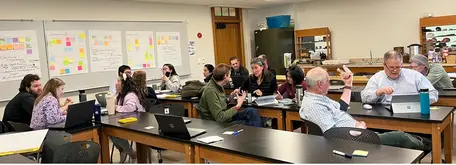
Participants in the workshop at the University of Arkansas wanted to focus on improving the learning outcomes for their three undergraduate degree programs and creating more continuity between courses in the programs. Facilitators David Gosselin and Karen Viskupic led participants in sessions on knowing your students; workforce needs and connections; identifying strengths, weaknesses, opportunities, and threats with respect to the undergraduate degree program (see Figure 1); brainstorming and then writing learning outcomes for the three undergraduate degree programs; and using a curriculum matrix for planning and identifying opportunities for assessment. In this workshop, the facilitators also met with a group of undergraduate students and conducted the strengths, weaknesses, opportunities, and challenges activity with them, relaying the results back to the faculty—an activity that everyone found valuable.
![[creative commons]](/images/creativecommons_16.png)
In workshop evaluations, one University of Arkansas participant's comment reflected several others': "The opportunity to spend a large chunk of time focused on one topic with my colleagues has been so helpful, impactful, and motivational!" Another said, "We had some of the most useful discussions on that bigger picture that we have had since I have been on the faculty."
Building strong courses: El Paso Community College
Workshops in the 'building strong courses' theme are focused on the course level, supporting individual instructors in implementing evidence-based practices in their courses, but recognizes that those instructors and their courses are housed within departments and/or larger programs, and changes are more likely to be sustained when supported within that larger context. In addition, individuals benefit from working together with their peers and colleagues as they share ideas and experiences using particular strategies and approaches.
The workshop at El Paso Community College (EPCC) was requested by one of the deans to support faculty as the institution was in the process of transforming their course schedule from 16-week semesters to 8-week "mini-mesters", with all classes offered in a more time-intensive hybrid modality. Unlike most TWPs, the workshop included participants from disciplines across the college, including the humanities and all STEM disciplines. Typical of many community colleges, EPCC has only one full-time geoscience faculty member. However, the nature of EPCC meant that the group was still coherent and all participants were facing the same challenge of revising their course to meet students' needs in an unfamiliar format.
My co-facilitator Kaatje Kraft and I led the participants in sessions on recognizing and elevating enduring concepts through backward design, aligning assessment with learning goals, facilitating discussions for learning, reimagining your syllabus, and active learning strategies (Figure 2). With a diverse group of 26 instructors from Art, Biology, English, Geology, Math, Philosophy, Physics, Political Science, Psychology, and more, the discussions were wide-ranging and rich.
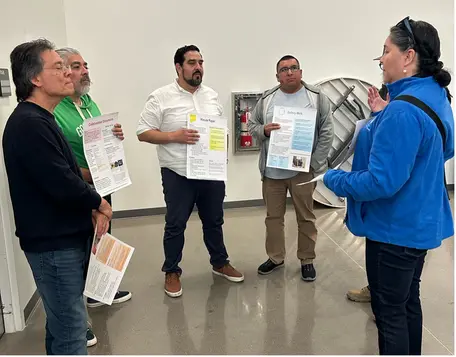
Many participants commented that they found our use of active learning strategies in the workshop valuable: they appreciated seeing a jigsaw, gallery walk, and facilitated whole-group discussion in action and could better imagine implementing those practices. They also expressed appreciation for the time to work with their colleagues in other disciplines and learn from them. We especially appreciated a comment in the end-of-workshop evaluation from a participant who said, "The most valuable insight was the shift from content-focused teaching to skills-based teaching. I realized that my role isn't just to cover material, but to develop students' abilities to apply, analyze, and evaluate psychological concepts/skills they'll use beyond my classroom. This reframed how I think about curriculum design and assessment."
Inclusive mentoring: Pasadena City College (virtual)
The inclusive mentoring workshop is highly adaptable to many types of affinity groups. It is particularly amenable to groups that are physically dispersed and thus benefit from an online/virtual workshop. Past inclusive mentoring workshops have been offered for scientists who mentor research interns at the Illinois State Geological Survey and at a dispersed undergraduate research program at the University of Texas at Austin.
Faculty at Pasadena City College (PCC) had written funding for this workshop into the budget of a grant proposal that would support PCC students in engaging in mentored research over the summer. When that grant funding was awarded, they worked with us to schedule and plan the workshop for the faculty who would be involved in student mentoring. Although all six participants taught at PCC, they lived across the greater Los Angeles area and appreciated the virtual setting to avoid substantial driving time.
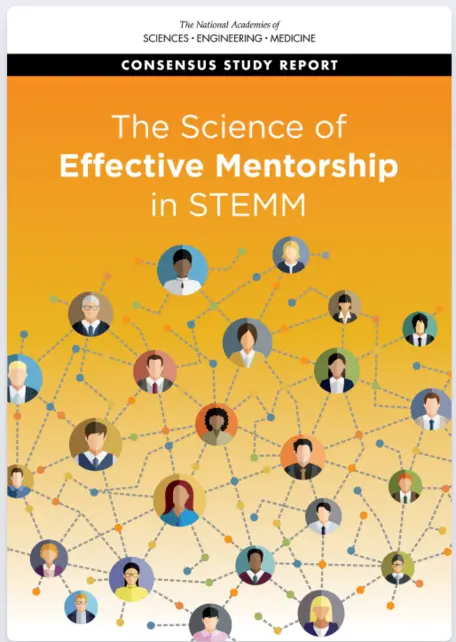
My co-facilitator Kaatje Kraft and I led the participants in sessions on mentorship and identity, establishing a mentoring network, establishing expectations and setting goals, and practicing communication. We met in two 3-hour Zoom sessions one week apart, so also included some reflective homework before each session. Some of the participants had not had positive experiences with their own mentors as students, and they appreciated the opportunity to acknowledge those experiences and learn about evidence-based practices that can counter their own experiences. This workshop draws heavily from a consensus study report on mentoring from the National Academies (Figure 3).
 Show caption
 Hide
HideSeveral of the participants noted that they wished they had had more time in the workshop to really work through the materials and discuss with colleagues. Virtual workshops present a challenge: trying to balance Zoom fatigue with the need for extended discussions that allow for deep learning and growth. Despite the near-unanimous desire for more time, participants appreciated the time they did have to develop their collective mentoring skills, saying it was "great... to build rapport," and how important it was to discuss mentorship styles and that they "don't have to shoulder the pressure of mentoring a student alone."
Transforming your introductory course: Rutgers University–Newark
The 'transforming your introductory course' theme is the most recently developed within the TWP. This theme emerged from a grant-funded project out of the recognition that introductory courses in the sciences (including geoscience) typically are not under the sole control of any one person to change: they are often taught by multiple faculty, include graduate and/or undergraduate teaching assistants, are part of general education programs, may be taught by high-school teachers through dual-enrollment programs, and are deeply embedded in the departmental culture. Changing them takes buy-in from everyone involved, and a shared vision for lasting, sustainable, and realistic change.
The department chair at Rutgers University–Newark learned about the workshop theme in a webinar and immediately requested a workshop. Because this was a new theme, we engaged three facilitators: Julie Bartley and Catherine Riihimaki joined me to lead this workshop.
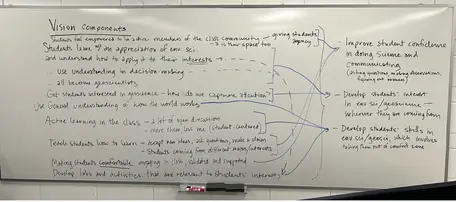
One of the unique aspects of this theme is the nature of the participants. Where most TWP workshops are for faculty and staff, this one is for people in a wider range of roles: everyone involved in making an introductory course happen was invited, including tenure-track faculty, lecturers, graduate teaching assistants, a staff person that supports the lab, and a high school teacher at a local high school. As facilitators, we acknowledged the power dynamics within the group and emphasized that everyone's voice was valued in these discussions. We then led the participants through sessions to envision their introductory courses, facilitating discussions for learning, creating an equitable learning environment starting with the syllabus, and effective teaching strategies. Throughout, the group had opportunities to engage in action planning for how they would carry the work forward after the workshop ended.
The visioning process was very powerful, and we left that work up on the white board throughout the workshop to keep grounding the work (Figure 4).
At the end of the workshop, one participant commented that the most valuable aspect of the workshop was, "The time and space to work on this and making space to say that change is possible." Another said, "I have never participated in this kind of collective training. It is meaningful to the work that needs to happen (course redesign), and it facilitates building the team within the department."
Summary
A common theme in all of the end-of-workshop evaluations is how much participants appreciate having the dedicated time and space to talk with their colleagues about the things that they are all deeply engaged in but rarely have the time to talk about. The external facilitation that the TWP provides helps keep those discussions productive and can help groups overcome old patterns of communication and interaction that get in the way of progress and break down seemingly insurmountable challenges into achievable goals and action plans. If you are part of a group that needs dedicated time and space to make change, you can read more about the TWP themes and request a workshop. We look forward to working with you.
References
Egger, A. E. (2024). Where did NAGT's Traveling Workshops Program come from? In the Trenches, 14(2), 2–3.
Egger, A. E., & Robinson, W. (2024). Geoscience departments can "phone a friend" for support. Eos, 105(9), 22–27. https://doi.org/10.1029/2024EO240266
Lee, V. S., Hyman, M. R., & Luginbuhl, G. (2007). The Concept of Readiness in the Academic Department: A Case Study of Undergraduate Education Reform. Innovative Higher Education, 32(1), 3–18. https://doi.org/10.1007/s10755-006-9032-6
National Academies of Sciences Engineering and Medicine (NASEM). (2019). The Science of Effective Mentorship in STEMM. The National Academies Press. https://doi.org/doi:10.17226/25568
Quan, G. M., Corbo, J. C., Finkelstein, N. D., Pawlak, A., Falkenberg, K., Geanious, C., Ngai, C., Smith, C., Wise, S., Pilgrim, M. E., & Reinholz, D. L. (2019). Designing for institutional transformation: Six principles for department-level interventions. Physical Review Physics Education Research, 15(1), 010141. https://doi.org/10.1103/PhysRevPhysEducRes.15.010141
Reinholz, D. L., Matz, R. L., Cole, R., & Apkarian, N. (2019). STEM Is Not a Monolith: A Preliminary Analysis of Variations in STEM Disciplinary Cultures and Implications for Change. CBE Life Sciences Education, 18(4). https://doi.org/doi:10.1187/cbe.19-02-0038
Reinholz, D. L., Ngai, C., Quan, G., Pilgrim, M. E., Corbo, J. C., & Finkelstein, N. (2019). Fostering sustainable improvements in science education: An analysis through four frames. Science Education, 103(5), 1125–1150. https://doi.org/https://doi.org/10.1002/sce.21526
Comment? Start the discussion about Creating time and space for change: The impact of NAGT’s 2025-26 Traveling Workshops Program